
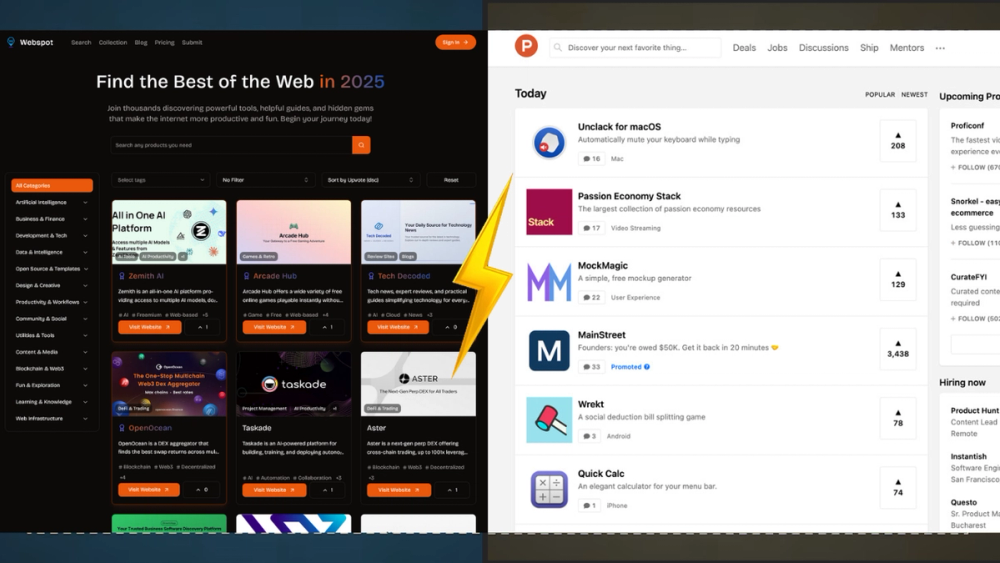
You've poured months into building your product. Now comes the moment that makes most founders break into a cold sweat: the launch.
Should you go with Product Hunt, the platform everyone talks about? Or try Webspot, the newer alternative promising better results for indie makers? The wrong choice could mean your launch falls flat, wasting precious time and momentum.
Here's the truth: both platforms can work, but they serve different founders with different goals. After analyzing hundreds of launches and talking to founders who've used both, I'll show you exactly which platform fits your situation—no fluff, just actionable insights.
Understanding the Landscape: Why Your Launch Platform Matters
Before we dive into the comparison, let's get real about what's at stake. Your launch platform isn't just about getting upvotes or traffic spikes. It's about finding your first real users, getting feedback that actually helps, and building momentum that carries beyond day one.
The launch platform landscape has shifted dramatically. Product Hunt, once the cozy community where any indie maker could shine, has evolved into a more competitive arena. Meanwhile, alternatives like Webspot have emerged specifically to address the pain points founders face with traditional platforms.
Product Hunt: The Industry Giant
What It Is: Product Hunt has been the go-to launch platform since 2013. With millions of monthly visitors and a community of early adopters, tech enthusiasts, and investors, it's become synonymous with product launches in the startup world.
The Strengths
Massive Reach: Product Hunt's audience is substantial. A successful launch can bring thousands of visitors in a single day. For products that resonate with their community, the exposure is unmatched.
Credibility Boost: There's real social proof in saying "We were #1 on Product Hunt." Investors, potential partners, and customers recognize the badge. It signals that your product has been vetted by a discerning community.
Media Attention: Tech journalists actively monitor Product Hunt for stories. A top-ranking launch can lead to press coverage, podcast invitations, and speaking opportunities.
Network Effects: The platform's size means more potential connections—investors scouting deals, potential co-founders, and strategic partners all browse Product Hunt regularly.
The Reality Check
It's Become Pay-to-Play: Recent data shows that top-ranked products typically have marketing budgets exceeding $2,000. Many hire specialized "Product Hunt consultants" to orchestrate launches. For bootstrap founders, this creates an uneven playing field.
Conversion Rates Are Dropping: While you might get impressive traffic numbers, conversion to paying customers often disappoints. Many founders report signup-to-customer conversion rates below 5%, with users who are more "launch tourists" than genuine prospects.
24-Hour Window: Product Hunt operates on a strict daily ranking system. If you don't gain traction in the first few hours, your product gets buried. The pressure is intense, and there's no second chance.
Community Fatigue: With hundreds of products launching weekly, even good products struggle to stand out. The community has become somewhat jaded, and genuine engagement is harder to earn.
Webspot: The Indie Maker's Alternative
What It Is: Webspot positions itself as a launch platform built specifically for indie makers, bootstrap founders, and side projects. It emphasizes community support over competition, with a focus on meaningful feedback rather than vanity metrics.
The Strengths
Founder-Friendly Economics: Webspot offers free launches for indie projects, with optional paid features that cost significantly less than a typical Product Hunt launch campaign. This levels the playing field for founders without marketing budgets.
Quality Over Quantity: By featuring fewer products daily (typically 3-5), each launch gets more visibility and attention. Your product won't be competing with 50 others on the same day.
Longer Visibility Window: Unlike Product Hunt's 24-hour cycle, products on Webspot remain discoverable for weeks or months. This creates sustained traffic rather than a single spike.
Genuine Community Engagement: The platform cultivates a supportive environment where makers help each other. Feedback tends to be constructive and actionable rather than superficial upvotes.
Better Conversion Rates: Early data suggests that Webspot users convert at higher rates—around 14% according to some reports—because the audience consists of builders genuinely interested in discovering useful tools.
The Trade-Offs
Smaller Audience: Webspot's reach is significantly smaller than Product Hunt's. You'll get hundreds or low thousands of visitors rather than tens of thousands.
Less Brand Recognition: Saying "We launched on Webspot" doesn't carry the same weight as Product Hunt in investor pitches or press releases. The platform is still building its reputation.
Limited Media Attention: Tech journalists don't actively monitor Webspot the way they do Product Hunt. Your chances of secondary press coverage are lower.
Newer Platform: With less history and fewer case studies, there's more uncertainty about long-term outcomes and platform stability.
Head-to-Head: The Practical Comparison
For Bootstrap Founders and Side Projects
Winner: Webspot
If you're building without venture funding, Webspot's economics make more sense. You can launch for free, get meaningful feedback, and achieve reasonable conversion rates without competing against well-funded startups with professional launch teams.
Product Hunt's competitive dynamics increasingly favor companies with resources to invest in launch day coordination, influencer outreach, and paid promotion. Unless you have $1,000+ to spend and an existing audience, you'll likely struggle to crack the top rankings where real visibility happens.
For VC-Backed Startups
Winner: Product Hunt
If you've raised funding and need to demonstrate traction to investors, Product Hunt's credibility and reach justify the investment. The social proof of a successful Product Hunt launch carries weight in board meetings and fundraising conversations.
The larger audience also matters more when you have aggressive growth targets. Even with lower conversion rates, the absolute numbers can be significant.
For Developer Tools and Technical Products
Winner: Product Hunt (with caveats)
Product Hunt's audience skews technical, making it ideal for developer tools, APIs, and infrastructure products. However, also consider Hacker News (Show HN) as a complementary or alternative channel—it's free and reaches a highly technical audience.
Webspot works too, but Product Hunt's established presence in the developer community gives it an edge for technical products.
For Consumer Apps and Broad Audiences
Winner: Depends on your goals
For consumer products, both platforms have limitations. Product Hunt's audience is tech-savvy early adopters, not necessarily your end users. Webspot's smaller community means less reach.
Consider your primary goal: if it's feedback and iteration (Webspot), or maximum exposure and press attention (Product Hunt). For many consumer apps, neither platform may be optimal—direct community building on Reddit, Twitter, or niche forums might serve you better.
For B2B SaaS
Winner: Webspot (slight edge)
B2B products often struggle on Product Hunt unless they have broad appeal. The platform's consumer-leaning audience doesn't always translate to B2B sales.
Webspot's more focused community and better conversion rates can be more valuable for B2B founders looking for early customers who'll actually pay, not just tire-kickers.
The Smart Play: Why Not Both?
Here's a strategy many successful founders use: launch on Webspot first, gather feedback, iterate, then do Product Hunt later.
The Sequential Launch Strategy:
- Soft Launch on Webspot (Month 1): Test messaging, gather feedback, identify issues, build initial user base
- Iterate Based on Feedback (Months 2-3): Fix bugs, improve onboarding, refine positioning
- Product Hunt Launch (Month 4): Go big with a polished product, testimonials from early users, and proven traction
This approach reduces Product Hunt launch risk while maximizing learning. You're not betting everything on a single 24-hour window with an unproven product.
Making Your Decision: A Framework
Ask yourself these questions:
Do you have a marketing budget over $1,000?
- Yes → Product Hunt is viable
- No → Start with Webspot
Is your primary goal press coverage and investor attention?
- Yes → Product Hunt
- No → Webspot
Do you need feedback more than traffic?
- Yes → Webspot
- No → Product Hunt
Can you mobilize an existing audience for launch day?
- Yes → Product Hunt can work well
- No → Webspot's longer visibility window helps
Are you building for a technical audience?
- Yes → Product Hunt (or Hacker News)
- No → Consider both, or Webspot first
The Bottom Line
Product Hunt isn't dead, but it's not the only game in town anymore. For well-funded startups with resources to invest in a coordinated launch, it remains powerful. The reach, credibility, and media attention can be game-changing.
But for indie makers, bootstrap founders, and side projects, Webspot offers a more accessible path. The supportive community, better economics, and higher conversion rates make it a smarter first step.
The best approach? Don't put all your eggs in one basket. Launch on Webspot to learn and iterate, build traction on multiple channels, and save Product Hunt for when you're ready to make a big splash with a proven product.
Your launch platform matters, but it's not everything. Great products find their audience through persistence, genuine value, and multiple channels—not a single launch day. Choose the platform that fits your resources and goals, then focus on building something people actually want.
That's what ultimately determines success, regardless of where you launch.
Key Takeaways
Product Hunt offers massive reach and credibility but increasingly favors well-funded startups with marketing budgets
Webspot provides better economics and conversion rates for indie makers and bootstrap founders
Consider a sequential strategy: launch on Webspot first for feedback, then Product Hunt later with a polished product
Match the platform to your goals: press attention and investors (Product Hunt), genuine users and feedback (Webspot)
Don't rely on a single launch: build multiple channels and focus on long-term product-market fit