You launch a new website. You’re excited. You hit publish.
And then… nothing.
No traffic. No rankings. Just silence.
That quiet period messes with people. It makes you question the design, the niche, the whole idea. But here’s the truth: ranking a new website in 90 days is possible. You just need focus. No shortcuts. No random blogging.
Let’s walk through what actually moves the needle.
The Reality of Ranking a New Website in 90 Days
When people ask how to rank a new website in 90 days, they usually imagine ranking for big competitive keywords. That’s not the play.
You’re not trying to outrank Amazon or HubSpot. You’re trying to:
- Rank for long-tail keywords
- Build topical authority
- Earn early trust signals
- Create upward momentum
SEO is compounding. Early wins are small. But they stack.
Think of search growth like this:
Search Growth = Technical Setup × Content Depth × Authority Signals
If one is weak, progress slows. If all three work together, rankings accelerate.
Phase 1 (Days 1–14): Build the Technical Foundation
Before content marketing. Before link building. You fix the base.
Google needs to crawl and understand your site instantly.
Clean Site Architecture
Keep your structure flat. No page should sit more than three clicks deep.
Organize your content into clear topic clusters. Use simple URLs. For example:
yourdomain.com/seo/how-to-rank-a-new-website
Logical structure improves crawl efficiency and helps distribute internal link equity.
Google explains site structure best in its own documentation:
https://developers.google.com/search/docs/crawling-indexing/site-structure
Essential Technical Setup
In the first two weeks, complete this checklist:
- Submit XML sitemap in Google Search Console
- Validate robots.txt
- Connect GA4
- Ensure mobile-first usability
- Improve Core Web Vitals
Core Web Vitals matter because they impact user experience. Slow sites leak trust. You can review performance benchmarks here:
A fast site won’t guarantee rankings. A slow one can absolutely block them.
Accelerate Indexing
After publishing a page:
- Link to it internally
- Request indexing in Search Console
- Share it on platforms where Google crawls often
Indexing speed matters early. Visibility creates feedback loops.
Phase 2 (Days 15–45): Build Topical Authority
Now the real work begins.
Random blog posts won’t rank a new website. Structured content will.
Target the Right Keywords
Focus on:
- Low competition keywords
- Specific search queries
- Buyer-adjacent informational searches
Ignore high-volume vanity keywords.
Manually analyze the SERP. Look at who ranks. If you see weak niche blogs, forums, or thin content, that’s opportunity.
Ahrefs offers a solid breakdown of keyword difficulty metrics:
https://ahrefs.com/blog/keyword-difficulty/
But don’t rely only on tools. Look at the actual results.
Use Topic Clusters
Instead of isolated posts, build clusters.
Picture this structure:
Pillar Page
↳ Supporting Article 1
↳ Supporting Article 2
↳ Supporting Article 3
Each supporting article links back to the pillar. The pillar links out to all supporting pieces.
This structure builds semantic relevance. It tells search engines your site covers the topic deeply.
When learning how to rank a new website in 90 days, this step separates success from frustration.
Publish Consistently
Aim for two to three high-quality posts per week.
Each article should:
- Fully answer the query
- Use clear headers
- Include internal links
- Stay between 1,200 and 2,000 words
Consistency builds authority signals. Sporadic posting slows momentum.
Phase 3 (Days 45–75): Earn Authority Signals
By now, you may see impressions in Search Console. Maybe even a few clicks.
But authority remains your bottleneck.
Why Backlinks Still Matter
Despite algorithm updates, backlinks remain powerful.
Google continues to refine spam detection as outlined in its link spam updates:
https://developers.google.com/search/blog
Quality matters more than quantity.
One contextual link from a relevant site can outperform fifty weak directory links.
Practical Link Building for Beginners
Start small and realistic:
- Contribute guest posts to niche blogs
- Offer expert quotes through journalist platforms
- Create data-driven content worth referencing
- Reach out to complementary sites
Relevance is critical. Links should reinforce your topic clusters.
Strengthen Internal Links
Internal linking distributes authority across your site.
When one page gains traction, you funnel that strength into other related pages.
Be intentional. Link where context makes sense. Avoid random linking.
Phase 4 (Days 75–90): Optimize What’s Already Working
Now you stop guessing.
Open Google Search Console.
Look for:
- Pages ranking between positions 8 and 20
- Keywords with impressions but low click-through rates
- Queries slightly misaligned with your content
These are leverage points.
Improve Click-Through Rate
Rewrite meta titles to be sharper and clearer. Add specificity. Use numbers where appropriate.
Small CTR gains can lift rankings because engagement signals improve.
Expand and Refine Content
If a page ranks on page two, expand it.
Add:
- Deeper explanations
- Clear examples
- FAQ schema where relevant
Structured data guidance is available here:
https://developers.google.com/search/docs/appearance/structured-data/faqpage
Optimization during this window often triggers meaningful jumps.
Common Mistakes That Kill New Website Rankings
Let’s be blunt.
- Targeting competitive keywords too early
- Buying cheap backlinks
- Publishing thin AI content without editing
- Ignoring internal linking
- Constantly redesigning your site
Each one resets momentum.
SEO rewards consistency and structure.
What to Expect After 90 Days
If you execute properly, you can expect:
- Rankings for long-tail keywords
- Growing impressions in Search Console
- Early backlinks
- Clear upward traffic trends
You probably won’t dominate competitive keywords yet. That takes longer.
But you will build momentum.
And momentum changes everything.
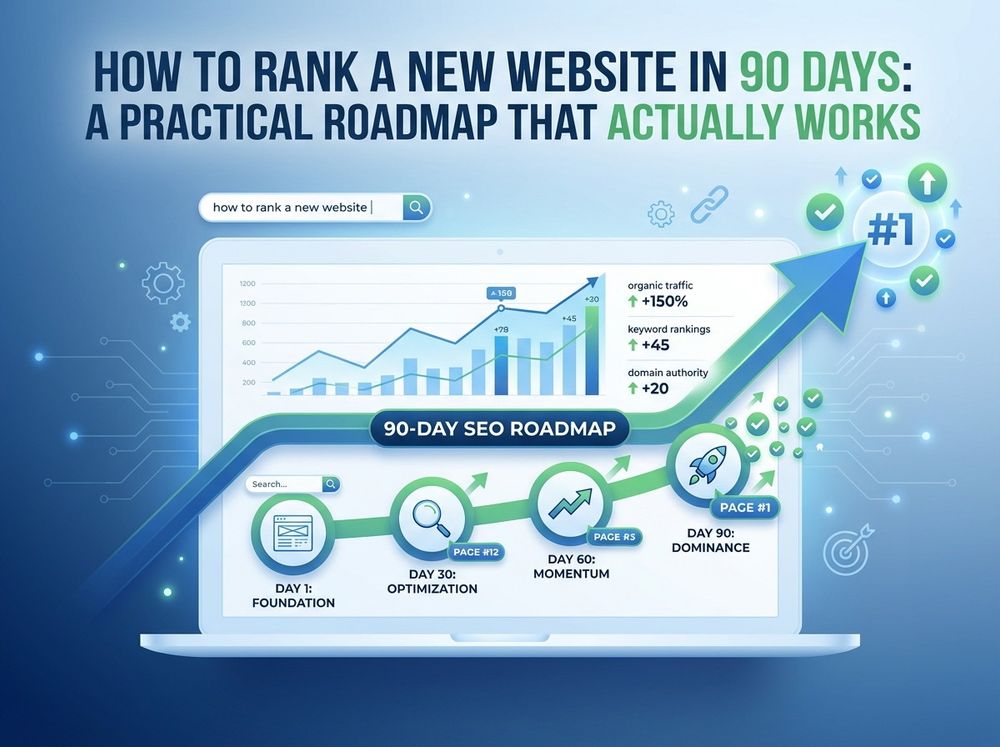
The 90-Day Execution Plan
Days 1–14: Fix technical SEO and site architecture
Days 15–45: Publish structured topic clusters consistently
Days 45–75: Earn relevant backlinks and strengthen internal links
Days 75–90: Optimize based on real data
That’s how to rank a new website in 90 days.
No hacks. No tricks.
Just disciplined execution.
Start today. Stay consistent. And let compounding work for you.